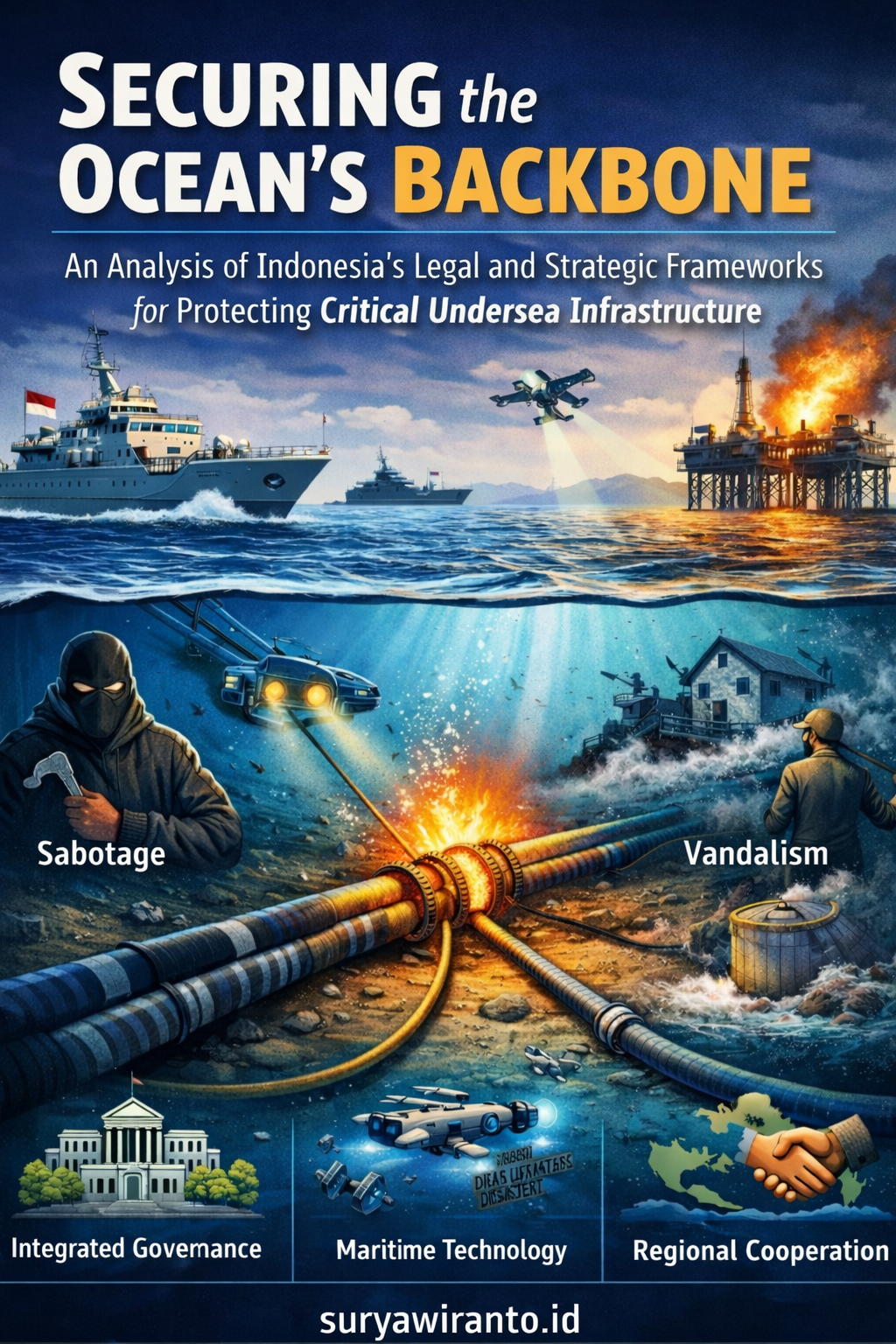
Abstract
This academic manuscript examines the complex challenge of securing critical undersea infrastructure (CUI) from Indonesia’s strategic and legal perspective. Submarine cables and pipelines, classified as National Vital Objects under Presidential Decree No. 63/2004, are indispensable for the national economy and data sovereignty, with global cables carrying an estimated 98% of international data traffic. The analysis identifies a multifaceted threat landscape ranging from geopolitical sabotage, as seen in the 2022 Nord Stream explosions, to persistent local vandalism and natural disasters. It critiques the current fragmented governance involving at least nine agencies and analyzes the operational reliance on the Indonesian Navy (TNI AL) despite a legal mandate for the National Police. The manuscript concludes by proposing an integrated, technology-enhanced governance model and regional cooperation frameworks to safeguard these vital subsea assets.
Keywords: Critical Undersea Infrastructure (CUI), Submarine Cables, Maritime Security, UNCLOS 1982, Indonesian National Vital Objects, Geopolitical Threats, Maritime Governance, TNI AL.
1. Context – The Submerged Lifelines of a Globalized Indonesia
The stability of the modern globalized economy and the security of the nation-state are increasingly dependent on a hidden network of physical assets lying on and beneath the ocean floor, collectively termed Critical Undersea Infrastructure (CUI). For the archipelagic nation of Indonesia, whose territory spans vital sea lanes like the Malacca Strait and encompasses over 17,000 islands, this infrastructure forms nothing less than the circulatory and nervous system of its national body. These assets include submarine telecommunications cables, which carry approximately 98% of global data traffic and underpin the digital economy; submarine power cables, such as those connecting Java to Bali and Sumatra to Bangka and Batam, which are essential for equitable energy distribution; pipelines for hydrocarbons; and emerging technologies like underwater data centers. The legal foundation for their protection in Indonesia is firmly established under Presidential Decree No. 63/2004 concerning the Security of National Vital Objects, which classifies any installation whose disturbance could impact the livelihoods of many people or state interests as a vital object requiring special protection. This definition seamlessly encompasses CUI, placing its security within the highest tier of national priority. Internationally, the United Nations Convention on the Law of the Sea (UNCLOS) 1982 provides the overarching legal framework, affirming in Articles 112-115 the freedom for all states to lay and maintain submarine cables and pipelines on the continental shelf and in the high seas, while also granting coastal states certain rights to adopt laws and regulations for cables entering their territorial sea. The strategic context, however, is one of increasing vulnerability. As Indonesia seeks to leverage its maritime geography for economic growth, the security of these submerged lifelines becomes a non-negotiable prerequisite, making their protection a central concern for maritime governance, national security policy, and international diplomacy in the Indo-Pacific region.
2. Problem Analysis – A Multilayered Threat Matrix to Subsea Stability
The criticality of undersea infrastructure inversely correlates with its accessibility, rendering it a prime target for a diverse and evolving matrix of threats that challenge both Indonesian sovereignty and global connectivity. These threats can be categorized into intentional malicious acts, unintentional damage, natural hazards, and systemic governance failures. At the geopolitical level, state and non-state actors are increasingly viewing CUI as a target of choice for hybrid warfare, owing to its low escalation threshold and high disruptive payoff. Historical precedents like the Cold War-era Operation Ivy Bells wiretapping and the catastrophic sabotage of the Nord Stream pipelines in September 2022 demonstrate the capability and intent of state actors. More recently, incidents in the Red Sea involving telecommunications cables and the persistent tensions in the Taiwan Strait highlight how strategic chokepoints are becoming flashpoints for subsea vulnerability. Parallel to these high-order threats, Indonesia faces an acute and persistent challenge from local vandalism driven by socioeconomic factors. The theft of copper from power cables, the dismantling of steel support structures, and even the removal of critical navigational or tsunami warning buoys for scrap metal represent a direct attack on national security and community safety, complicating the threat picture by blending criminality with human security issues. Beyond human action, the immense forces of nature pose a constant risk, as exemplified by the January 2022 volcanic eruption and tsunami in Tonga which severed the sole submarine cable connecting the kingdom, causing a near-total communications blackout. Unintentional damage from ship anchoring, bottom-trawling fishing gear, and future seabed mining activities further compounds the risk environment. A profound systemic problem exacerbates all these threats: the disorganized management of the infrastructure itself. In Indonesian waters, the chaotic tangle of an estimated 217 cable segments (a reduction from 349, yet still highly complex) creates a mapping and monitoring nightmare. This labyrinth increases the risk of accidental damage and obscures malicious activity, making any coherent security response extraordinarily difficult to mount and coordinate effectively.
3. Problem Analysis (Continued) – Governance Fragmentation and Capability Gaps
The analysis of threats naturally leads to an examination of the institutional and operational frameworks designed to counter them, revealing significant gaps between legal mandates, bureaucratic reality, and on-water capability. In Indonesia, the governance and security of CUI are fragmented across a minimum of nine government agencies, historically under the guidance of the Coordinating Ministry for Maritime and Investment Affairs. This multiplicity of stakeholders, while reflecting the cross-sectoral nature of CUI, often results in overlapping jurisdictions, diluted accountability, and hampered inter-agency coordination. A critical legal-operational dissonance is evident in the security mandate itself. While Presidential Decree No. 63/2004 explicitly designates the Indonesian National Police (Polri) as the lead agency for the physical security of National Vital Objects, in practical terms, the role of patrolling and securing vast maritime zones and underwater assets has fallen predominantly to the Indonesian Navy (TNI AL). This de facto arrangement stems from the Polri’s limited blue-water and sub-surface capabilities, but it creates a potential legal grey area and underscores a capability deficit in civilian maritime security institutions. Other agencies, such as the Sea and Coast Guard (KPLP) and the Marine Police (Polairud), are largely confined to surface patrols due to a lack of specialized training, equipment, and budgetary allocation for underwater operations. The TNI AL’s Hydro-Oceanographic Center (Pushidrosal) plays a crucial role in mapping seabed topography and charting underwater objects, including CUI, yet this data is not always integrated into a unified, real-time operational picture accessible to all relevant security and regulatory bodies. This fragmentation is mirrored in prevention measures, such as the establishment of no-anchoring zones or the dissemination of navigational warnings, which suffer from inconsistent enforcement and poor coordination among Indonesia’s seven maritime security agencies and with neighboring states, leaving CUI perilously exposed in a region characterized by intense shipping traffic and complex sovereignty claims.
4. Proposed Solutions – Towards an Integrated Governance and Enhanced Awareness Model
Addressing the twin challenges of multifaceted threats and fragmented governance requires a holistic solution set centered on legal harmonization, institutional integration, and technological empowerment. The primary focus must be the creation of a unified and streamlined governance architecture. This could be realized through a Presidential Regulation specifically dedicated to Critical Undersea Infrastructure, which would formally establish a lead agency, logically a strengthened and specially mandated directorate within the reformed Coordinating Ministry for Maritime Affairs and Fisheries, with clear authority to coordinate all other entities. This lead body would oversee a National CUI Registry and Digital Seabed Map, integrating data from Pushidrosal, cable owners, and survey companies into a single, secure platform accessible for planning, monitoring, and emergency response. Legally, the dissonance between Decree No. 63/2004 and operational reality should be resolved, either by formally amending the decree to reflect TNI AL’s lead role in the maritime domain for CUI protection, or by radically enhancing the Polri’s Polairud unit with dedicated subsea security vessels, remotely operated vehicles (ROVs), and diver teams to fulfill its original mandate. Technologically, Indonesia must invest in a layered surveillance and detection system. This includes expanding the fleet of multi-role offshore patrol vessels equipped with advanced hull-mounted and towed-array sonars, acquiring Autonomous Underwater Vehicles (AUVs) for routine inspection of cable routes, and exploring cost-effective seabed sensor networks for critical chokepoints like the Sunda and Lombok Straits. Furthermore, a comprehensive prevention regime must be enforced, involving mandatory coordination with the lead agency for any seabed activity (including fishing, anchoring, and future mining), stringent penalties for vandalism treated as a crime against national vital objects, and proactive public awareness campaigns in coastal communities to turn them from potential threats into active stewards of the infrastructure upon which their own digital and economic futures depend.
5. Action Plan – Implementing a Phased and Collaborative Security Strategy
The translation of these solutions into actionable policy requires a phased, resource-informed strategy with clear milestones. Phase One (Years 0-2) must focus on institutional and legal foundation-laying. The immediate task is the drafting and issuance of the specific Presidential Regulation on CUI Security, followed by the establishment of the lead coordination agency and the technical development of the National CUI Registry. Concurrently, a comprehensive legal review should reconcile security mandates and propose necessary amendments to relevant laws. Initial capability investments should target the procurement of at least two dedicated, multi-role CUI security vessels for TNI AL or an empowered Polairud, equipped with ROVs and side-scan sonar, and the training of specialized dive and investigation teams. Phase Two (Years 2-5) shifts to scaling capability and deepening integration. This involves expanding the AUV fleet for regular patrols, achieving full integration of the CUI registry with national maritime domain awareness systems like Indonesia’s Sea Surveillance System (SSS), and conducting large-scale, inter-agency table-top and live exercises simulating various CUI disruption scenarios. Crucially, this phase must prioritize international and regional cooperation. Indonesia should proactively initiate and formalize joint CUI protection protocols within existing frameworks like the Malacca Strait Patrol, extending cooperation to include information-sharing on cable routes and coordinated surface patrols. It should also champion regional dialogues, possibly under the ASEAN framework, to develop norms of behavior and incident response protocols for CUI, drawing lessons from the Australia-Singapore Cable security agreement. Phase Three (Years 5+) aims at achieving advanced resilience. This includes exploring public-private partnerships with cable consortiums for real-time monitoring technology, investing in strategic national capability for rapid cable repair (such as securing access to a cable-laying vessel), and fostering domestic innovation in underwater surveillance and robotics to reduce long-term costs and build indigenous expertise. Throughout all phases, a dedicated budget line within the national defence and security budget, potentially supplemented by a levy on cable operators, is essential to ensure sustainable funding for this critical national mission.
6. Conclusion – Securing the Depths for National Resilience and Global Responsibility
The security of critical undersea infrastructure is no longer a niche technical concern but a fundamental imperative for Indonesia’s economic resilience, digital sovereignty, and national security in the 21st century. The analysis reveals a landscape where global geopolitical tensions, local criminality, and natural hazards converge on assets that are both indispensable and inherently vulnerable. While the legal foundations for protection exist, they are undermined by a fragmented bureaucratic landscape and a mismatch between formal mandates and operational capabilities. The path forward necessitates a decisive break from business-as-usual. Indonesia must consolidate its approach by establishing clear leadership, harmonizing its laws, and making targeted investments in sub-surface maritime security capabilities. Success in this endeavor, however, cannot be achieved in isolation. As a major archipelagic state straddling the world’s most critical maritime crossroads, Indonesia has both a responsibility and a strategic interest in shaping regional norms for CUI protection. By moving from a reactive posture to a proactive, integrated, and cooperative strategy, Indonesia can secure its own submerged lifelines while contributing to the stability and security of the global digital commons. The challenge is immense, spanning the vastness of its waters and the complexity of its governance, but the cost of failure, a severed digital artery, a paralyzed energy grid, or a compromised national security secret, is far greater. Protecting the ocean’s backbone is, ultimately, about safeguarding the future of the nation itself.
Note;
This manuscript was presented at the Embassy of the Netherlands as part of providing teaching material for the delegation of the Netherlands Young Defence Delegation (Jong Defensie/JD), with the topic; “Critical Maritime Infrastructure (CMI) and Critical Underwater Infrastructure (CUI) from Indonesia’s perspective”. Tuesday, February 3, 2026.
The author, Dr. Surya Wiranto, SH MH, is a retired Rear Admiral of the Indonesian Navy, Advisor to Indo-Pacific Strategic Intelligence (ISI), Senior Advisory Group member of IKAHAN Indonesia-Australia, Lecturer at the Postgraduate Program on Maritime Security at the Indonesian Defense University, Head of the Kejuangan Department at PEPABRI, Member of FOKO, Secretary-General of the IKAL Strategic Center and Executive Director of the Indonesia Institute for Maritime Studies (IIMS). He is also active as a Lawyer, Receiver, and Mediator at the Legal Jangkar Indonesia law firm ⚓️.
Bibliography
- Republic of Indonesia. (2004). Presidential Decree Number 63 of 2004 concerning the Security of National Vital Objects.
- United Nations. (1982). United Nations Convention on the Law of the Sea (UNCLOS).
- Indonesian Navy Hydro-Oceanographic Center (Pushidrosal). (2023). Annual Report on Seabed Mapping and Maritime Charting.
- International Cable Protection Committee (ICPC). (2023). Recommendations on the Protection of Submarine Cables from External Aggressions.
- Bateman, S., & Tsamenyi, M. (2023). The Security of Submarine Cables in the Indo-Pacific: A Regional Perspective. Australian National University Press.
- Kraska, J., & Pedrozzo, R. (2022). International Maritime Security Law. Brill Nijhoff.
- Indonesian Coordinating Ministry for Maritime and Investment Affairs. (2024). White Paper on Integrated Maritime Security Strategy.
- Global Forum on Cyber Expertise (GFCE). (2023). Protecting Undersea Communications Infrastructure: A Cyber-Physical Security Challenge.
- MacDonald, K. (2022). After Nord Stream: The Vulnerability of Undersea Infrastructure. Survival: Global Politics and Strategy, 64(6), 47-58.
- TNI AL Headquarters. (2023). Doctrine for the Protection of Maritime Vital Objects. Indonesian Navy Publishing.