US-Iran Escalation, Trump’s Strategic Anomaly, and Indonesia as a Normative Middle Power in a Fragmenting International Order
Abstract
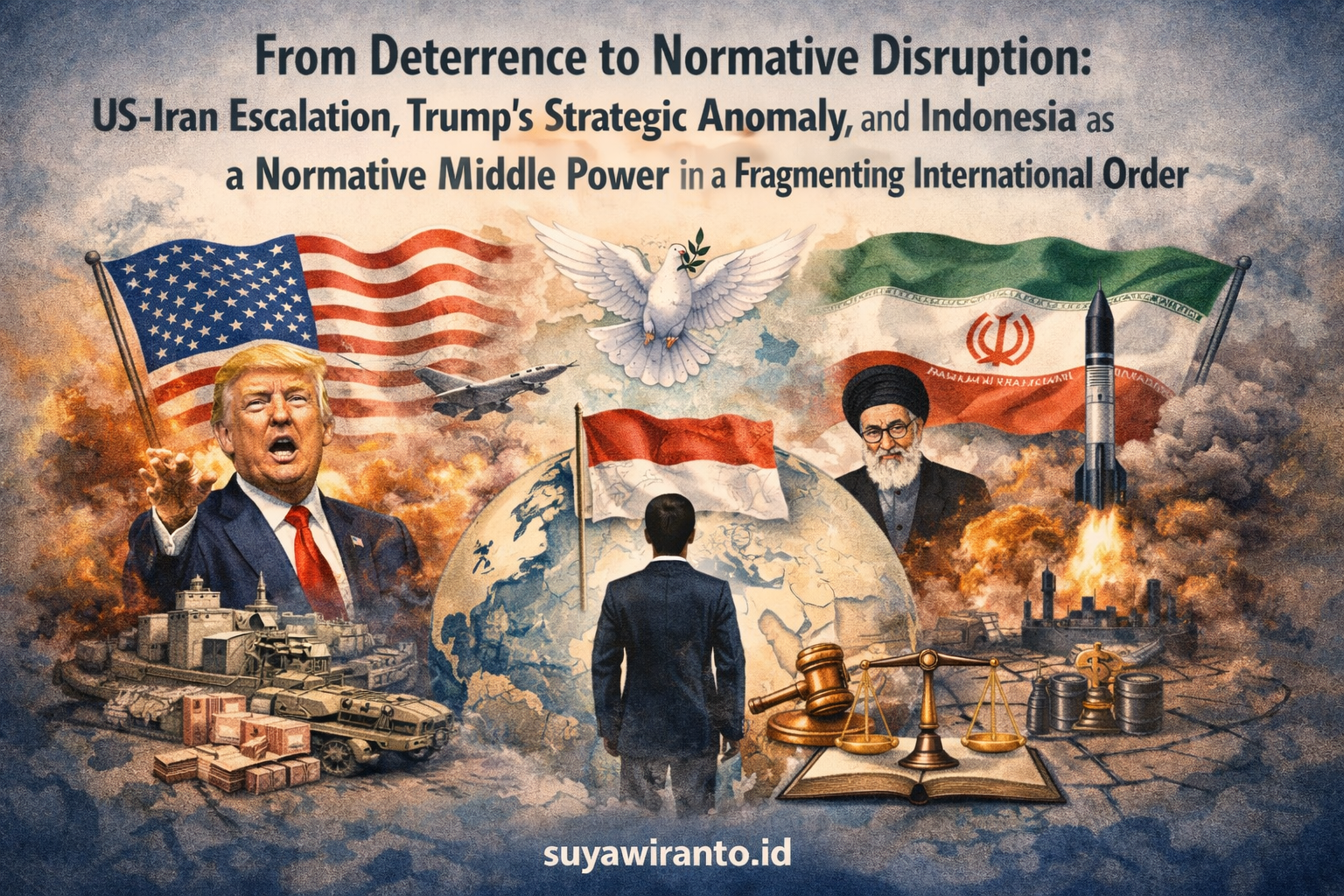
The renewed escalation between the United States and Iran during 2025–2026 exposes a structural transformation in global security governance, where deterrence increasingly operates outside the confines of international law. The deployment of USS Abraham Lincoln, the paralysis of the Joint Comprehensive Plan of Action (JCPOA), and the selective mobilisation of International Atomic Energy Agency (IAEA) reports illustrate the erosion of rule-based multilateralism in favour of coercive diplomacy. Simultaneously, Donald Trump’s Gaza Board of Peace initiative reveals a growing tendency to bypass United Nations–mandated peacebuilding norms, marginalising self-determination and legal consent. This article argues that these developments constitute a crisis of normative authority in the international order rather than isolated regional disputes. Focusing on Indonesia, the article conceptualises its foreign policy role as a normative middle power, whose strategic relevance lies in legal advocacy, coalition leadership within the Global South, and resistance to institutional bypassing. It concludes that Indonesia’s credibility in an increasingly coercive world depends on transforming international law from moral rhetoric into strategic practice.
Keywords: deterrence; international law; JCPOA; Gaza; normative middle power; Indonesian foreign policy; multipolar order.
1. Introduction: Coercion as Governance
The escalation of tensions between the United States and Iran in 2025–2026 reflects a broader transformation in global order: the gradual replacement of rule-based security governance with coercion as a governing logic. The deployment of USS Abraham Lincoln to the Middle East did not signal preparation for conventional war, but rather exemplified a contemporary form of deterrence characterised by ambiguity, signalling, and escalation control. In this model, military assets function less as instruments of decisive force and more as political technologies designed to shape behaviour without legal accountability.
This transformation cannot be separated from the erosion of multilateral legal authority. The Joint Comprehensive Plan of Action (JCPOA), endorsed by UN Security Council Resolution 2231, represented a rare convergence of diplomacy, verification, and international law. Its effective collapse following unilateral US withdrawal in 2018 initiated a spiral of reciprocal non-compliance that has rendered legal commitments contingent on power asymmetry rather than consent.
The re-emergence of Donald Trump as a central strategic actor intensifies this condition. His Gaza Board of Peace initiative illustrates how peacebuilding itself has become detached from international legal frameworks. By circumventing UN mechanisms and excluding Palestinian political agency, the initiative reframes occupation as a managerial problem rather than a legal violation, signalling a shift from law-based peace to power-mediated stability.
For Indonesia, these developments pose a structural dilemma. As a long-standing advocate of non-alignment, international law, and anti-colonialism, Indonesia derives diplomatic influence not from coercive capabilities but from normative credibility. This article asks whether such credibility remains viable in a global environment increasingly hostile to legal restraint, and how Indonesia can strategically reposition itself as a normative middle power rather than a passive rule-taker.
2. Theoretical Framework: Normative Middle Power in an Age of Institutional Bypass
This article advances the concept of normative middle power by integrating middle power theory with constructivist and legal-institutionalist approaches. Traditional middle power theory emphasises coalition-building and multilateral activism. However, in an era where powerful states increasingly bypass institutions, middle power relevance hinges on the capacity to defend, reinterpret, and operationalise norms under adverse conditions.
Normative power, as conceptualised by Manners, is not merely ideational but performative. Norms acquire strategic value only when translated into institutional practice and collective action. Legal institutionalism further demonstrates that selective enforcement erodes regime legitimacy, incentivising defection and norm contestation.
Indonesia’s normative middle power status rests on three pillars. First, legal consistency, particularly in non-proliferation, self-determination, and humanitarian law. Second, coalitional leadership within the Global South and ASEAN. Third, strategic restraint, understood not as passivity but as resistance to legitimising extra-legal coercion.
3. US-Iran Escalation and the Structural Failure of Nuclear Governance
The JCPOA collapse illustrates the vulnerability of arms control regimes under conditions of power asymmetry. While Iran’s uranium enrichment reportedly reached approximately 60 percent by 2025, this development must be understood within a legal context shaped by sanctions reimposition and the absence of reciprocal compliance. The politicisation of IAEA reporting has further undermined confidence in the neutrality of verification mechanisms.
The deeper crisis lies in the asymmetrical application of non-proliferation norms. Israel’s long-standing undeclared nuclear capability, shielded from inspection and legal scrutiny, exposes the selective morality underpinning the regime. This double standard weakens the normative foundations of the NPT and reframes compliance as strategic vulnerability.
The deployment of USS Abraham Lincoln thus functions less as a response to nuclear breakout risk than as a substitute for diplomatic failure. Military signalling replaces legal adjudication, reinforcing a security logic detached from international law.
4. Gaza Board of Peace and the Normalisation of Extra-Legal Peacebuilding
The Gaza Board of Peace exemplifies a new modality of peacebuilding divorced from legal consent. Unlike UN-mandated missions grounded in collective legitimacy, the initiative operates through ad hoc authority, excluding Palestinian political actors and prioritising demilitarisation without accountability.
This approach reframes occupation as a technical challenge, obscuring its legal status under international humanitarian law. By de-politicising injustice, such mechanisms risk entrenching asymmetric power relations while claiming neutrality. The result is not sustainable peace, but institutionalised inequality.
Indonesia’s engagement with this initiative reveals a critical test of normative consistency. Participation without explicit legal conditionality risks undermining Indonesia’s constitutional mandate to oppose colonialism and its international reputation as a principled actor.
5. Indonesia as a Normative Middle Power: From Moral Voice to Strategic Actor
Indonesia’s relevance in a fragmenting order depends on transforming normative commitment into strategic practice. This requires moving beyond rhetorical multilateralism toward assertive legal diplomacy. Indonesia should condition participation in peace initiatives on UN mandates, inclusivity, and accountability mechanisms.
Within the Global South, Indonesia can exercise leadership by coordinating collective positions on non-proliferation equity and humanitarian law enforcement. Such coalitions increase the political cost of institutional bypassing and reinforce legal norms through numbers rather than force.
Under President Prabowo, whose foreign policy emphasises strategic autonomy and national resilience, normative middle power diplomacy aligns with realist interests. International law becomes not a constraint, but a force multiplier compensating for material asymmetry.
6. Conclusion: International Law as Indonesia’s Strategic Asset
The US-Iran escalation and the Gaza Board of Peace initiative illustrate a global order in which coercion increasingly displaces consent and legality. For Indonesia, abandoning normative commitments would not enhance strategic flexibility but erode its primary source of influence. In an unequal international system, law is Indonesia’s strategy. Preserving and operationalising it is not idealism, but rational statecraft.
References
- Acharya, A. (2014). The End of American World Order. Polity Press.
- Acharya, A. (2018). Global International Relations and regional worlds.
- International Studies Quarterly, 62(1), 1–16.
- George, A. L. (1991). Forceful Persuasion: Coercive Diplomacy as an Alternative to War. USIP Press.
- Manners, I. (2002). Normative power Europe. Journal of Common Market Studies, 40(2), 235–258.
- Freedman, L. (2004). Deterrence. Polity Press.
- Waltz, K. (1979). Theory of International Politics. McGraw-Hill.
- Finnemore, M. (2003). The Purpose of Intervention. Cornell University Press.
- International Atomic Energy Agency. (2024–2025). Verification and Monitoring in Iran.
- UN Security Council Resolution 2231 (2015).
- Treaty on the Non-Proliferation of Nuclear Weapons (1968).
- Treaty on the Prohibition of Nuclear Weapons (2017).
- Krasner, S. (1999). Sovereignty: Organized Hypocrisy. Princeton University Press.
- Orford, A. (2011). International Authority and the Responsibility to Protect. Cambridge University Press.
- Wajah Strategi Global Trump: ‘Peace Or War’? | DON CAST https://www.youtube.com/live/Yl5kwilBfes?si=oBM1KOL17yF-s8du