Abstract
The Indo-Pacific security environment is undergoing structural transformation driven by great power rivalry and systemic uncertainty. This paper analyzes the 2026 Jakarta Treaty between Indonesia and Australia as an institutional innovation designed to preserve strategic autonomy among middle powers. Using the agency-preservation architecture framework, this study argues that structured consultation, interoperability, and joint capacity-building expand operational maneuver space without compromising sovereign control over national defense decisions. Legally grounded in Indonesia’s constitutional sovereignty and free and active foreign policy doctrine, the treaty offers a third pathway between alliance dependency and passive neutrality. Its implementation demonstrates how middle powers actively shape regional order while strengthening defense, economic resilience, and cooperative security in a contested strategic environment.
Keywords: Indo-Pacific security, strategic autonomy, middle powers, Jakarta Treaty 2026, agency preservation
- Context, Indo-Pacific Security Architecture and the Middle Power Moment
The Indo-Pacific region is undergoing a structural transformation marked by intensifying geopolitical competition, growing strategic fragmentation, and increasing uncertainty regarding the durability of the rules-based international order established after the Second World War. The evolving rivalry between the United States and the People’s Republic of China has reshaped regional strategic dynamics, creating systemic pressure on middle powers to navigate competing centers of power while preserving sovereign decision-making autonomy. This transformation extends beyond conventional military competition and includes economic interdependence, critical mineral supply chains, maritime control, technological infrastructure, and financial influence, all of which now function as instruments of strategic leverage. The structural implications of this shift were highlighted during the World Economic Forum Annual Meeting held in Davos on 21 January 2026, when Canadian Prime Minister Mark Carney warned that the “old order will not return” and emphasized that middle powers must actively cooperate to avoid becoming passive objects of great power competition. His statement reflected the emerging consensus that strategic autonomy, defined as the capacity of states to independently determine national policy without coercion, has become a central objective for middle powers in the contemporary international system.
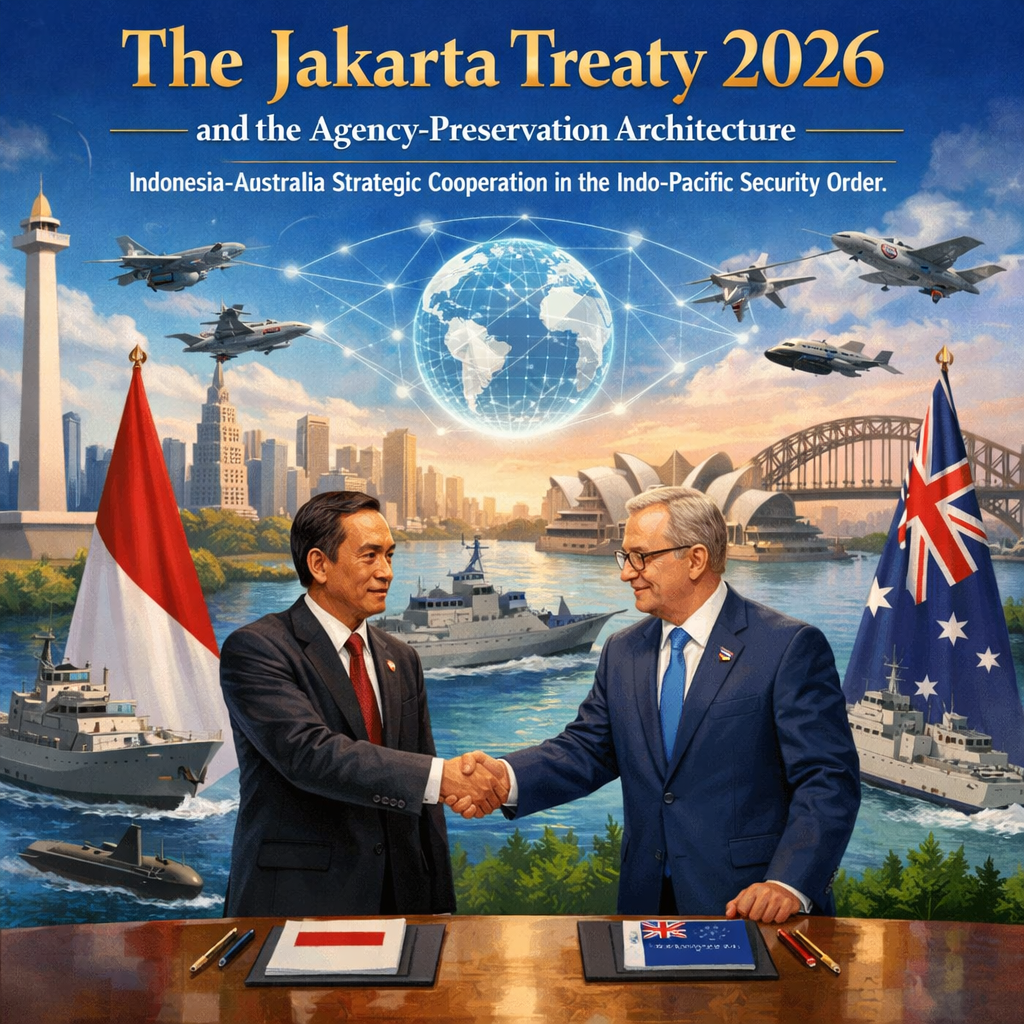
Within this evolving strategic environment, Indonesia and Australia signed the Jakarta Treaty on 5 February 2026, marking a significant milestone in bilateral security cooperation. Australian Prime Minister Anthony Albanese stated that the treaty responded to “challenging times” and elevated bilateral relations to an unprecedented level of strategic partnership. This agreement builds upon decades of cooperation, including the 1995 Agreement on Maintaining Security signed during the administrations of Prime Minister Paul Keating and President Suharto. However, unlike previous arrangements, the Jakarta Treaty institutionalizes formal consultation mechanisms, crisis coordination frameworks, and joint capacity-building initiatives that expand operational cooperation while preserving national command authority. Its legal legitimacy is grounded in Article 11 of the Constitution of the Republic of Indonesia of 1945, which authorizes the government to conclude international agreements for national security purposes, and Law No. 37 of 1999 on Foreign Relations, which establishes Indonesia’s free and active foreign policy doctrine. This doctrine mandates engagement in international cooperation while preserving independence and rejecting binding military alliances, thereby ensuring that national sovereignty remains intact.
The treaty’s institutional design reflects a broader shift in how middle powers approach security cooperation in an increasingly polarized environment. Rather than forming formal alliances with automatic defense obligations, middle powers are developing structured cooperation frameworks that function as operational enablers rather than hierarchical command systems. These frameworks expand maneuver space by facilitating consultation, interoperability, and coordinated response without transferring sovereign authority. This approach aligns with the strategic perspective articulated by Australian Foreign Minister Penny Wong during her address at the Australian Institute of International Affairs on 17 November 2025, in which she emphasized that regional states must actively shape their strategic environment rather than passively accept outcomes determined by great powers. The Jakarta Treaty therefore represents an institutional adaptation to systemic uncertainty, illustrating how middle powers are transitioning from passive participants into active architects of regional security order while preserving sovereign autonomy.
2. Problem Analysis – Strategic Autonomy Under Structural Pressure
The central strategic dilemma facing middle powers in the Indo-Pacific lies in balancing cooperative security engagement with the preservation of sovereign autonomy in an increasingly polarized environment. For Indonesia, this challenge is closely linked to its constitutional identity and foreign policy doctrine. President Prabowo Subianto, during the joint press conference on 5 February 2026, emphasized that the Jakarta Treaty was consistent with Indonesia’s free and active foreign policy and reaffirmed that Indonesia would not join military alliances or permit permanent foreign military bases. This position reflects Article 1 paragraph (2) of the 1945 Constitution, which establishes that sovereignty resides with the people and must be exercised independently by the state. Consequently, any security cooperation agreement must strengthen Indonesia’s national defense capability without compromising its independent authority over the use of military force. This constitutional and legal framework creates structural constraints that require innovative institutional arrangements capable of enhancing security cooperation while preserving sovereign decision-making.
From Australia’s perspective, the challenge emerges from the evolving structure of alliance dependence and uncertainty regarding the long-term trajectory of United States strategic engagement in the Indo-Pacific. Although the Australia-United States alliance remains fundamental, shifting global priorities and resource allocation have encouraged Australia to diversify its strategic partnerships. A policy brief published by the UWA Defence and Security Institute in September 2025 emphasized that Australia must recalibrate its strategic posture to maintain operational flexibility in response to rapidly evolving regional threats. This recalibration reflects recognition that middle powers must develop independent strategic capacity while maintaining cooperative relationships to avoid excessive reliance on a single external security provider.
The complexity of preserving strategic autonomy is further intensified by the rise of non-traditional security threats that transcend national boundaries. During the 11th Australia-Indonesia Ministerial Council Meeting on Law and Security held in Jakarta on 28 January 2026, both governments identified terrorism, cyber threats, irregular migration, and transnational crime as critical shared challenges. These threats require rapid information sharing, coordinated operational responses, and institutional interoperability, which cannot be achieved through isolated national efforts. Without structured cooperation mechanisms, middle powers risk strategic vulnerability due to fragmented responses and limited operational reach. The challenge therefore lies in designing institutional arrangements that enhance collective capacity without compromising sovereign authority, a requirement that traditional alliance models cannot fully satisfy in politically sensitive environments.
3. Solution – Agency-Preservation Architecture as Institutional Innovation
The Jakarta Treaty 2026 offers an institutional solution to the structural dilemma faced by middle powers by establishing what can be conceptualized as an agency-preservation architecture, defined as a formalized framework of consultation, coordination, and capacity-building mechanisms designed to expand strategic maneuver space while preserving sovereign control over national security decisions. Unlike traditional alliance arrangements based on collective defense obligations, this architecture emphasizes procedural integration without command integration, enabling participating states to strengthen operational effectiveness while maintaining independent authority over the use of force. This distinction is critical because it ensures that cooperation enhances national capability rather than replacing it, thereby preserving the core principle of sovereign equality enshrined in Article 2(1) of the Charter of the United Nations. Furthermore, the treaty’s legal validity is grounded in the Vienna Convention on the Law of Treaties of 1969, which affirms the sovereign right of states to conclude agreements consistent with their constitutional frameworks, reinforcing Indonesia’s legal authority under Article 11 of its 1945 Constitution and Law No. 24 of 2000 on International Treaties.
One of the most strategically significant initiatives announced alongside the treaty is Australia’s offer to place senior Indonesian military officers within the Australian Defence Force institutional structure. This initiative enhances interoperability, defined as the ability of military forces to operate effectively together, by providing Indonesian officers with direct exposure to Australian operational planning processes, strategic assessments, and decision-making procedures. Such exposure improves mutual understanding and coordination while preserving sovereign command authority because embedded officers serve as liaison personnel rather than operational commanders. This arrangement reflects a capacity-enhancement model that strengthens national defense capabilities without creating dependency, thereby aligning with Indonesia’s national defense doctrine as codified in Law No. 3 of 2002 on National Defense, which emphasizes strengthening domestic defense capacity through international cooperation while maintaining national independence.
Another key component of the agency-preservation architecture involves the development of joint training facilities located within Indonesian sovereign territory. These facilities provide physical infrastructure for joint exercises, professional military education, and interoperability development, enabling both countries to enhance operational readiness and coordination. Conducting such activities within Indonesia ensures compliance with constitutional restrictions on foreign military presence, which reflect Indonesia’s historical sensitivity regarding sovereignty and territorial integrity. By maintaining Indonesian jurisdiction over training facilities, the arrangement ensures that sovereignty remains intact while enabling both countries to benefit from cooperative capacity development. This approach also reflects the principle of defensive realism, in which states enhance their security through cooperative measures designed to increase deterrence and reduce vulnerability without provoking escalation.
The treaty also includes expanded military education and exchange programs designed to cultivate long-term institutional trust and strategic familiarity between future military leaders. Strategic trust, defined as confidence in the reliability and intentions of partner states, is a critical factor in preventing miscalculation and enhancing crisis stability. By fostering interpersonal relationships and institutional familiarity, these exchange programs create informal communication channels that facilitate rapid coordination during crises, thereby strengthening collective resilience without formal alliance obligations. This long-term investment in human capital reflects recognition that effective security cooperation depends not only on material capabilities but also on institutional relationships and mutual confidence developed over time.
In addition to defense cooperation, the treaty incorporates economic security components through a memorandum of understanding between Australia and Indonesia’s sovereign wealth management authority, Danantara. This economic dimension reflects the growing recognition that economic resilience is inseparable from national security in the modern strategic environment. President Prabowo Subianto explicitly invited Australian investment in Indonesia’s critical mineral sector, including nickel, copper, bauxite, and gold, which are essential for advanced manufacturing, energy transition, and defense industries. This initiative aligns with Indonesia’s economic development strategy under Law No. 25 of 2007 on Investment, which promotes foreign investment to strengthen national economic resilience while maintaining regulatory control. By integrating defense cooperation with economic security initiatives, the Jakarta Treaty creates a multidimensional institutional framework that strengthens both military and economic resilience, thereby enhancing overall strategic autonomy.
4. Action – Operational Implementation and Strategic Capacity Enhancement
The implementation of the Jakarta Treaty demonstrates how institutional design translates into operational capability through concrete cooperative activities that enhance national and collective security capacity. Maritime security cooperation represents one of the most critical operational domains, reflecting the geographic reality that Indonesia and Australia share extensive maritime boundaries that are strategically vital for trade, resource management, and national defense. Coordinated patrol operations, including Operation JAWLINE-ARAFURA and Operation GANNET, have strengthened maritime domain awareness, defined as the effective understanding of maritime activities that could impact national security, safety, or economic interests. These operations involve joint surveillance, information sharing, and law enforcement coordination to combat illegal fishing, smuggling, and transnational maritime crime. Such activities are consistent with Indonesia’s sovereign rights under the United Nations Convention on the Law of the Sea of 1982, which Indonesia ratified through Law No. 17 of 1985, granting Indonesia jurisdiction over its exclusive economic zone and responsibility for protecting marine resources.
Cybersecurity cooperation has also emerged as a central component of operational implementation, reflecting the growing importance of digital infrastructure in national security. The renewal of the memorandum of understanding between Indonesia’s National Cyber and Crypto Agency and Australia’s Department of Foreign Affairs and Trade on 20 August 2025 established mechanisms for joint cyber exercises, threat intelligence sharing, and infrastructure protection. These activities enhance national cyber resilience, defined as the ability to prevent, withstand, and recover from cyber threats. This cooperation aligns with Indonesia’s legal obligations under Law No. 11 of 2008 on Electronic Information and Transactions, which mandates the protection of national digital infrastructure and information systems. By enhancing cybersecurity capacity, the treaty strengthens Indonesia’s ability to protect critical infrastructure from external interference, thereby reinforcing national sovereignty in the digital domain.
Counterterrorism cooperation represents another key area of operational implementation, reflecting the persistent threat posed by transnational extremist networks. Joint training programs conducted at the Jakarta Centre for Law Enforcement Cooperation enhance investigative capabilities, intelligence coordination, and crisis response effectiveness. These programs operate within Indonesia’s legal framework under Law No. 5 of 2018 on Counterterrorism, which authorizes international cooperation to combat terrorism while preserving national legal jurisdiction. By improving operational readiness and coordination, these initiatives enhance Indonesia’s ability to respond effectively to security threats while strengthening bilateral cooperation.
Migration management cooperation has also been strengthened through Australian funding for specialized training programs and infrastructure development in Indonesia. These initiatives enhance border security capacity and support effective migration management in accordance with international legal standards. By strengthening institutional capacity, these programs contribute to regional stability while supporting Indonesia’s sovereign authority over its borders.
5. Regional Context – Middle Power Strategic Adaptation and the Diffusion of Agency-Preservation Architecture in the Indo-Pacific
The Jakarta Treaty 2026 must be understood not as an isolated bilateral development but as part of a broader structural transformation in Indo-Pacific security architecture, in which middle powers are increasingly adopting institutional strategies designed to preserve strategic autonomy while adapting to intensifying great power competition. This transformation reflects the diffusion of what may be described as agency-preservation logic, whereby states construct overlapping networks of security cooperation, economic interdependence, and institutional coordination to reduce strategic vulnerability without surrendering sovereign control. This pattern is particularly visible in Japan, whose security posture has undergone significant recalibration in response to a deteriorating regional security environment. Following revisions to its National Security Strategy in December 2022 and subsequent increases in defense spending that aim to reach two percent of gross domestic product by 2027, Japan has sought to strengthen deterrence capacity while maintaining constitutional constraints derived from Article 9 of its Constitution, which renounces war as a sovereign right. Rather than abandoning its constitutional framework, Tokyo has pursued capacity enhancement and expanded partnerships, demonstrating how agency preservation can be achieved through institutional adaptation rather than structural realignment.
A similar pattern can be observed in the Republic of Korea, where evolving threat perceptions and alliance dynamics have driven efforts to enhance national defense autonomy. The United States–Republic of Korea alliance remains central to Korean security, but shifting strategic priorities have encouraged Seoul to expand indigenous defense capabilities, including the development of advanced submarine platforms and domestic missile defense systems. These initiatives are grounded in Korea’s sovereign right to self-defense under Article 51 of the Charter of the United Nations and reflect a deliberate effort to strengthen national deterrence capacity while preserving alliance cooperation. By enhancing its own capabilities, South Korea reduces the risk of strategic abandonment while simultaneously minimizing the risk of entrapment in conflicts that may not align with its national interests, thereby preserving strategic maneuver space within the alliance framework.
India’s strategic behavior provides an even more explicit example of agency preservation through diversified institutional engagement. Historically committed to strategic autonomy as a core foreign policy principle since independence in 1947, India has adapted this doctrine to contemporary geopolitical conditions by participating in multiple cooperative frameworks without entering binding alliance commitments. India’s involvement in the Quadrilateral Security Dialogue alongside the United States, Japan, and Australia strengthens its strategic coordination in areas such as maritime security, infrastructure development, and technological cooperation, while its continued defense and energy relationships with Russia and economic engagement with China demonstrate its commitment to maintaining independent strategic options. This multidirectional engagement reflects India’s interpretation of sovereignty as the preservation of decision-making independence, consistent with its constitutional allocation of foreign policy authority to the executive branch under Articles 73 and 246 of the Constitution of India.
In Southeast Asia, similar agency-preservation strategies are evident in the policies of Vietnam and the Philippines, both of which have expanded security partnerships while avoiding exclusive alignment. Vietnam’s defense policy, articulated in its 2019 National Defense White Paper, explicitly adopts the principle of “four nos,” including no military alliances and no foreign military bases, reflecting a commitment to sovereignty preservation while expanding defense cooperation with multiple partners. The Philippines, following its recalibration of relations with China after withdrawing from certain Belt and Road Initiative projects in 2023, has strengthened defense cooperation with Japan, Australia, and the United States while maintaining economic engagement with China. These examples demonstrate that agency preservation has become a regional pattern rather than an isolated national strategy.
Within this regional context, the Jakarta Treaty represents a particularly significant institutional innovation because it formalizes agency preservation through legally binding consultation mechanisms rather than informal strategic alignment. By embedding cooperation within treaty-based institutional structures consistent with international law, including the Vienna Convention on the Law of Treaties of 1969, the agreement enhances predictability, transparency, and durability. This institutionalization reduces uncertainty and strengthens mutual confidence, thereby enhancing deterrence stability. The treaty’s multidimensional design, encompassing defense, economic, cyber, and law enforcement cooperation, reflects recognition that strategic autonomy in the contemporary era requires integrated resilience across multiple domains.
The regional diffusion of agency-preservation strategies suggests that the Indo-Pacific is evolving toward a decentralized security architecture characterized by overlapping institutional networks rather than rigid alliance blocs. In this emerging environment, middle powers are not merely adapting to great power competition but actively shaping the structural conditions under which that competition unfolds. The Jakarta Treaty therefore represents both a national strategic instrument and a regional structural innovation, demonstrating how middle powers can collectively construct institutional frameworks that preserve sovereignty while enhancing security.
6. Conclusion – Strategic Implications and the Future of Indo-Pacific Security Architecture
The Jakarta Treaty 2026 represents a landmark development in the evolution of Indo-Pacific security architecture, demonstrating how middle powers can actively shape regional order through institutional innovation designed to preserve sovereign autonomy while enhancing cooperative security capacity. Its significance lies not only in its immediate operational implications but also in its broader structural impact on how security cooperation is conceptualized and implemented in an era of systemic uncertainty. By institutionalizing structured consultation, interoperability development, and multidimensional capacity-building mechanisms, the treaty expands strategic maneuver space for both Indonesia and Australia while ensuring that ultimate decision-making authority remains under national control. This institutional design reflects a deliberate effort to reconcile the competing imperatives of cooperation and sovereignty, which have historically been viewed as mutually exclusive within traditional alliance systems.
From a legal perspective, the treaty reinforces the principle that international cooperation can strengthen sovereignty rather than undermine it when conducted within constitutional and legal frameworks. Indonesia’s participation is firmly grounded in Article 11 of the 1945 Constitution and Law No. 37 of 1999 on Foreign Relations, both of which authorize international agreements that support national interests while preserving independence. Similarly, Australia’s participation reflects its sovereign authority under its constitutional framework to conclude international agreements that enhance national security. By operating within these legal parameters, the treaty demonstrates that sovereignty and cooperation are not contradictory but complementary when structured appropriately. This legal-institutional approach enhances legitimacy, ensuring domestic political support and long-term sustainability.
Strategically, the treaty illustrates how middle powers can exercise agency within a hierarchical international system by constructing institutional mechanisms that expand their influence without requiring formal alliance integration. This approach reflects a shift away from dependency-based security models toward capacity-based cooperation models, in which states enhance their own capabilities while benefiting from collaborative arrangements. By strengthening national defense capacity, economic resilience, and technological security simultaneously, the treaty creates a comprehensive security framework capable of addressing both traditional and non-traditional threats. This multidimensional approach reflects the evolving nature of security in the twenty-first century, in which economic stability, technological resilience, and institutional coordination are as critical as military capability.
The treaty also has significant implications for the broader regional security environment because it contributes to the development of a decentralized and resilient Indo-Pacific security architecture. Rather than reinforcing rigid bloc confrontation, the agreement promotes flexible institutional cooperation that reduces the risk of polarization and escalation. By creating mechanisms for consultation and coordination, the treaty enhances transparency and reduces uncertainty, which are essential for maintaining strategic stability. This stabilizing effect is particularly important in an environment characterized by rapid military modernization, technological competition, and geopolitical rivalry.
Furthermore, the treaty strengthens deterrence by increasing the operational capacity and institutional connectivity of participating states. Deterrence in this context is achieved not through formal alliance commitments but through enhanced capability, coordination, and credibility. By demonstrating the ability to cooperate effectively while maintaining sovereign independence, Indonesia and Australia increase the strategic costs of coercion by potential adversaries. This approach reflects the principle of deterrence by denial, in which enhanced resilience reduces vulnerability and discourages aggression.
Ultimately, the Jakarta Treaty represents a forward-looking model for middle power cooperation in an increasingly complex international system. It demonstrates that middle powers are not passive objects of great power competition but active agents capable of shaping their strategic environment through institutional innovation. As similar agreements and cooperative frameworks continue to emerge across the Indo-Pacific, the agency-preservation architecture pioneered by Indonesia and Australia may serve as a foundational model for the future regional order. In an era defined by uncertainty and competition, the ability of middle powers to preserve autonomy while strengthening cooperation will play a decisive role in determining whether the Indo-Pacific evolves toward fragmentation or stability. The Jakarta Treaty therefore stands not only as a bilateral agreement but as a structural blueprint for sustaining sovereignty, stability, and strategic balance in the twenty-first century Indo-Pacific.
Author Bio
Dr. Surya Wiranto is a Rear Admiral (Ret.) of the Indonesian Navy (TNI AL) and a senior strategic analyst specializing in Indo-Pacific security and maritime issues. He serves as an Advisor for Indo-Pacific Strategic Intelligence (ISI) and is affiliated with several Indonesian and international strategic and defense institutions. Dr. Wiranto lectures on Maritime Security and the International Law of the Sea at the Republic of Indonesia Defense University, and writes on middle-power diplomacy, geoeconomics, and the Indo-Pacific regional order.
Refference:
- Anthony Albanese, “Joint Media Statement – Jakarta, Indonesia,” Prime Minister of Australia, February 5, 2026.
- Penny Wong, “Keynote Address,” Australian Institute of International Affairs, November 17, 2025.
- United Nations, Charter of the United Nations, June 26, 1945, Article 2(1).
- Government of Indonesia, The 1945 Constitution of the Republic of Indonesia, Article 11.
- Government of Indonesia, Law No. 37 of 1999 on Foreign Relations.
- Vienna Convention on the Law of Treaties, May 23, 1969.
- Prabowo Subianto and Anthony Albanese, “Joint Press Conference,” Jakarta, February 5, 2026.
- William T. Tow and Brendan Taylor, “Australia’s Strategic Choices in the Indo-Pacific,” Australian Journal of International Affairs 74, no. 4 (2020): 361–377.
- UWA Defence and Security Institute, Traditional and Non-Traditional Challenges: Expanding the Australia-Indonesia Security Nexus, Policy Brief, September 2025.
- Ministry of Home Affairs Australia and Government of Indonesia, “Joint Communiqué – 11th Ministerial Council Meeting on Law and Security,” January 28, 2026.
- Reff tulisan Surya ???