Abstract
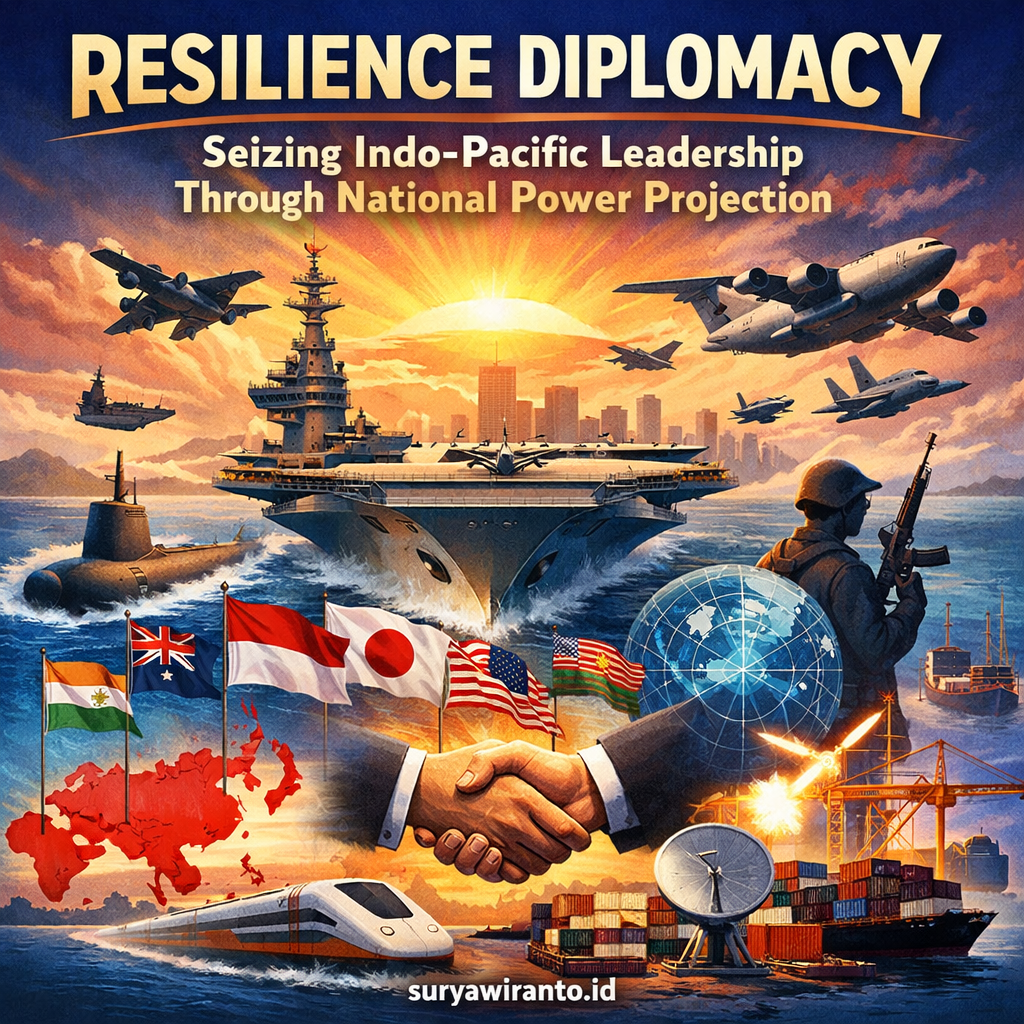
Amidst global fragmentation and the erosion of the multilateral order, the administration of President Prabowo Subianto has introduced Resilience Diplomacy as a foreign policy doctrine. Through the Annual Press Statement of the Minister for Foreign Affairs on January 14, 2026, this concept was positioned as a response to global uncertainty and the selective application of international law. However, this academic paper argues that without a clear operational definition and strategic priorities, resilience diplomacy risks becoming merely a defensive risk management instrument. Employing a critical analysis framework, this paper offers a paradigm shift from ‘resilience as survival’ to ‘resilience as influence’. Three main pillars are proposed: first, strengthening ASEAN as the gravitational center of diplomacy to prevent strategic marginalization; second, integrating military modernization and maritime strategy to create credible deterrence; and third, projecting Indonesian leadership within the Indo-Pacific architecture. The ultimate goal is to ensure that Indonesia not only weathers the geopolitical storm but is capable of shaping the direction of regional stability as a respected regional maritime power.
Keywords: Resilience Diplomacy, Free and Active Foreign Policy, Maritime Axis, ASEAN Centrality, Defense Modernization, Indo-Pacific
1. Introduction and Strategic Context
1.1. Global Disruption and Indonesia’s Position
The world has entered a phase of fragmentation unprecedented since the end of the Cold War. On January 14, 2026, Minister for Foreign Affairs Sugiono, in his Annual Press Statement, provided a firm diagnosis of the international condition: the world is fragmenting, international law is applied selectively, and global governance is eroding. This statement is not merely annual diplomatic rhetoric but a reflection of the geopolitical reality facing Indonesia. The release of the United States’ National Security Strategy for 2025 has affirmed the Indo-Pacific as the main theater of strategic competition, with the rise of Japan as a full-fledged defense actor and the creation of coalition architectures that often sideline ASEAN mechanisms. On the other hand, China’s expanding influence in the South China Sea continues to approach Indonesia’s areas of jurisdiction around the Natuna Islands. It is in this context that the administration of President Prabowo Subianto is reformulating foreign policy through the lens of resilience, a concept that promises preparedness, autonomy, and the protection of citizens in an increasingly uncertain world.
The constitutional foundation for this foreign policy direction is, in fact, firmly embedded in the Preamble to the 1945 Constitution of the Republic of Indonesia, which explicitly mandates the government to participate in establishing a world order based on freedom, lasting peace, and social justice. This mandate is further elaborated in Law Number 37 of 1999 concerning Foreign Relations, which affirms that Indonesia’s foreign policy is free and active and dedicated to the national interest. Resilience diplomacy, within this framework, should become an instrument to achieve these constitutional goals, not narrow them down to mere self-preservation efforts from external pressures. Therefore, strengthening this legal foundation is crucial so that resilience diplomacy does not lose the ‘free and active’ spirit that, since the 1955 Asia-Africa Conference, has positioned Indonesia as an architect of the world order, not merely a spectator on the sidelines of geopolitics.
1.2. Conceptual Ambiguity of Resilience Diplomacy
Although it sounds timely and relevant, Foreign Minister Sugiono’s speech did not provide an adequate operational definition of what is actually meant by resilience diplomacy. The concept appears stretched so broadly that it encompasses almost all domains of statehood: from food resilience, energy security, to defense modernization. In the speech, the statement that foreign policy “begins at home” indeed emphasizes the importance of building domestic capacity but fails to explain the transmission mechanism between internal strength and external bargaining power. Consequently, resilience diplomacy becomes trapped in the mistaken assumption that strengthening domestic institutions will automatically increase international influence. In fact, the history of Indonesian foreign policy shows that international influence is not born automatically from domestic strength alone, but from the courage to translate national capacity into regional strategic agendas. When President Soekarno initiated the Asia-Africa Conference or when President Soeharto, together with other ASEAN leaders, signed the Declaration of ASEAN Concord in Bali in 1976, what occurred was not merely the projection of internal power, but a deliberate political construction to shape the regional order according to national interests.
The latent danger of this conceptual ambiguity is the tendency to securitize foreign policy. If almost all external challenges are treated as security problems, then the logic of response will be dominated by defense and risk management approaches, not by preventive diplomacy and cooperative development. In the discourse developing within the Coordinating Ministry for Political and Security Affairs, for instance, achieving targets in the Asia Power Index has become the main benchmark for defense development success. The target of increasing the Military Capability Index score from 15.7 in 2024 to 20 by 2029, as well as adding TNI personnel from 458,201 to 847,654 in the same period, are technically valid indicators. However, if this becomes the dominant narrative, then diplomacy will be reduced to merely a supporting instrument for the defense posture. Resilience diplomacy that is only oriented towards risk management will give birth to a reactive foreign policy that loses the capacity for agenda-setting in international forums.
2. Problem Analysis: Defensive, Reactive, and Directionless
2.1. Marginalization of ASEAN and Absence of Regional Leadership
One of the most obvious consequences of the still-vague approach to resilience diplomacy is the minimal emphasis on strengthening ASEAN as the main platform of Indonesian foreign policy. In the Minister for Foreign Affairs’ Annual Press Statement, although the importance of new bilateral partnerships was mentioned, the portion discussing ASEAN was relatively limited. Yet, in the 2025–2029 National Medium-Term Development Plan (RPJMN) prepared by the Ministry of National Development Planning/ Bappenas, strengthening Indonesia’s leadership in the region is one of the main priorities. Data shows that in 2024, Indonesia’s Diplomatic Influence value in the Asia Power Index stood at 65.6, with a target increase to 66.1 by 2029. Achieving this target will be impossible if Indonesia reduces the intensity of its engagement in ASEAN institutions.
The reality on the ground shows that US-China rivalry has spurred the birth of various new security architectures that tend to marginalize ASEAN. The rise of minilateral mechanisms like AUKUS (Australia-United Kingdom-United States) and the strengthening of the Quad’s (Quadrilateral Security Dialogue) role create norm competition in the region that is not always aligned with the ASEAN Outlook on the Indo-Pacific (AOIP) initiated by Indonesia in 2019. If resilience diplomacy is understood merely as an effort to reduce risk by forging as many bilateral partnerships as possible without strengthening ASEAN’s collective foundation, Indonesia will actually face the major powers individually. Indonesia’s bargaining position in bilateral negotiations with the United States, China, or Japan would be far weaker than if Indonesia spoke on behalf of the 11 ASEAN member states. With Timor-Leste’s accession as a full member in 2025, ASEAN possesses greater demographic and geopolitical legitimacy to become the center of stability in the Indo-Pacific. As the largest country, Indonesia has the historical responsibility to ensure that ASEAN remains an independent “common home,” not a proxy arena for external powers.
2.2. Absence of Norms and Strategic Agenda
Further analysis of Foreign Minister Sugiono’s speech reveals the absence of mention of normative issues that have long been characteristic of Indonesian diplomacy. Terms like democracy, human rights, and the rules-based international order are not mentioned at all. Even the United States, which has been Indonesia’s main strategic partner in defense, is not explicitly mentioned. Yet, during the 2024–2025 period, Indonesia-US defense cooperation continued through various joint military exercise programs and the education of TNI personnel in the United States. This reluctance to explicitly name strategic partners may be intended to maintain autonomy and balance in free and active politics, but in practice, it creates a dangerous narrative vacuum.
The issue of climate change, for example, was framed more as a source of systemic risk in the speech rather than as a collective action problem requiring international cooperation. Yet, as the largest archipelagic state in the world with over 17,000 islands, Indonesia has the greatest stake in cooperation to control climate change. If resilience diplomacy only views climate change as a risk to be managed internally, then Indonesia misses the opportunity to lead global initiatives such as the Blue Economy or sustainable marine ecosystem management. At the ASEAN-UN Summit meeting in Kuala Lumpur in October 2025, Foreign Minister Sugiono himself stated that true strength lies in collaboration, not confrontation, and the need for ASEAN and the UN to build a rules-based multipolar order. Ironically, this spirit of collaboration is not yet fully reflected in the narrative of resilience diplomacy, which tends to emphasize aspects of self-defense and protection.
2.3. The Securitization Cycle of Foreign Policy
The mindset underlying defensive resilience diplomacy is not a new phenomenon in Indonesian history. In the late 1950s to early 1960s, Indonesia’s security institutions underwent massive expansion into civilian government, not solely because of real threats, but because of weak civilian institutions and daily crises being narrated as existential threats. Over time, extraordinary security policies hardened into governance routines. By 2026, a similar logic began to be projected outward into foreign policy. Domestically, this phenomenon is evident from the increasingly intensive involvement of the TNI in civilian tasks such as food production through the ‘cetak sawah’ (new rice field development) program, infrastructure development in remote areas, and forest area management. If this mindset is not corrected soon, resilience diplomacy risks hardening into a doctrine that views the outside world solely as a source of threats to be managed, rather than a political arena to be shaped.
Within a policy analysis framework, the securitization of diplomacy will have serious long-term consequences. First, economic policy can easily be reframed as national security policy, making protectionism and market access restrictions seem legitimate. Second, technology governance will be directed toward threat mitigation through restrictions on technology transfer and international partnerships, instead of through research collaboration and innovation. Third, bilateral relations will be measured solely by their contribution to risk reduction, not by the potential for joint value creation and strategic trust-building. Consequently, diplomacy becomes reactive by design, where every international engagement must be justified by risk reduction logic, not by a long-term political vision. This is the greatest irony of resilience diplomacy: the effort to protect autonomy may actually erode Indonesia’s capacity to act autonomously on the global stage.
3. Solutions: Transformation Towards Projective Diplomacy
3.1. From Defensive Resilience to Leadership Projection
To escape this defensive trap, resilience diplomacy must be fundamentally transformed from the paradigm of ‘resilience as survival’ to ‘resilience as influence’. This means that resilience must not stop at the ability to survive but must develop into the ability to shape the strategic environment. The history of Indonesian foreign policy proves that the ‘free and active’ principle was never intended as a passive doctrine. When the Asia-Africa Conference was held in Bandung in 1955, Indonesia was not merely surviving the pressures of the Cold War, but actively shaping a new political movement that changed the world geopolitical map. Similarly, when Indonesia, together with Malaysia, the Philippines, Singapore, and Thailand, signed the Bangkok Declaration in 1967, what occurred was the projection of regional leadership to create a stable security architecture in Southeast Asia. 21st-century resilience diplomacy must revive this projective spirit, with concrete agendas including leadership in the Indo-Pacific security architecture, active maritime diplomacy, and the shaping of regional norms favorable to Indonesia.
Strategic steps already taken by the government, such as the signing of a defense cooperation agreement with Australia in November 2025, are a suitable foundation for building this projective posture. The agreement, which deepens the 2006 Lombok Treaty, creates mechanisms for national security consultations, joint exercises, intelligence sharing, and maritime surveillance coordination that strengthen Indonesia’s ability to secure strategic sea lanes in the Sunda, Lombok, and Makassar Straits. However, this bilateral cooperation must be placed within a larger strategic framework: the development of a southern stability axis connecting Indonesia with Australia, and more broadly with other middle powers such as India, South Korea, and Vietnam. Thus, resilience diplomacy is no longer merely a hedging instrument between major powers but becomes the foundation for building a bloc of middle powers sharing common interests in maintaining the stability and openness of the Indo-Pacific.
3.2. Strengthening ASEAN as the Gravitational Center of Diplomacy
The second, equally important transformation is restoring ASEAN as the gravitational center of Indonesian diplomacy. The minimal emphasis on ASEAN within the current resilience diplomacy framework has the potential to strategically weaken Indonesia’s position. The argument is simple but fundamental: without ASEAN, Indonesia will face major powers bilaterally, which structurally places it in an unfavorable asymmetrical position. Conversely, by effectively leading ASEAN, Indonesia can shape the regional balance of power, maintain strategic autonomy, and prevent the dominance of external powers in Southeast Asia. In the context of increasingly sharp US-China rivalry, ASEAN functions as a strategic buffering instrument enabling Indonesia to conduct free and active politics effectively. ASEAN is not merely a regional forum for annual meetings of ministers and heads of state, but a collective platform that multiplies Indonesia’s diplomatic strength.
Therefore, the government needs to take the initiative to revitalize the ASEAN Outlook on the Indo-Pacific (AOIP), which was produced at the 34th ASEAN Summit in Bangkok in 2019. The AOIP must be translated into concrete actions whose benefits can be felt by the people of the region. Programs such as trilateral maritime patrols between Indonesia, the Philippines, and Malaysia to maintain shipping lane security in the Sulawesi Sea and Sulu Sea need to be intensified. Disaster management collaboration involving military and civilian forces from all ASEAN countries needs to be built with a more responsive mechanism, without having to wait for time-consuming consensus. At the same time, Indonesia must consistently strive to ensure that all regional security mechanisms, including those initiated by external powers, continue to respect ASEAN centrality. In every forum such as the East Asia Summit (EAS) and the ASEAN Regional Forum (ARF), Indonesia’s position must be firm: the Indo-Pacific architecture must be inclusive, transparent, and based on international law, not on exclusive military alliances that divide the region.
3.3. Integrating Military Modernization with Maritime Strategy
The third transformation, which is a prerequisite for the previous two, is the integration of resilience diplomacy with military modernization and maritime strategy to create credible deterrence. Effective diplomacy depends not only on normative rhetoric but also on the state’s ability to defend its interests tangibly. In the history of international relations, states with strong military and economic capacities have a greater ability to maintain foreign policy autonomy. In the context of Indonesia as the world’s largest archipelagic state, maritime power is the core of strategic credibility. Data from the Coordinating Ministry for Political and Security Affairs shows that the government targets a significant increase in defense posture through the procurement of 42 Rafale fighter aircraft from France, the construction of advanced frigates, and the procurement of surface-to-surface and surface-to-air missiles to be placed in border areas and outermost islands.
Concrete implementation of this strategy has been seen in the North Natuna area, which has become a testing ground for the credibility of Indonesia’s resilience diplomacy. On October 24, 2025, the Indonesian Navy increased patrol frequency and deployed frigate-class warships such as KRI Belati 622 as well as KCR-60 fast missile boats equipped with modern weaponry systems. Ranai Air Base in Natuna was also strengthened with the deployment of F-16 Fighting Falcon fighter jets and reconnaissance drones for 24-hour monitoring capable of detecting foreign vessel movements from hundreds of kilometers away. The results are beginning to show: in the last three months, 12 foreign vessels were successfully expelled from Natuna waters without physical conflict escalation, indicating that Indonesia’s deterrence strategy is starting to bear fruit. The government also allocated a budget of IDR 729 billion for 2025 to build maritime defense infrastructure in the area, including a military dock capable of accommodating destroyer-class warships, upgraded coastal radar with a range of up to 200 nautical miles, and logistics facilities to support long-term military operations. This combination of hard power, active diplomacy through ASEAN forums and UNCLOS 1982 mechanisms, and defense infrastructure development should serve as a model for resilience diplomacy across all areas of Indonesia’s jurisdiction.
4. Action: Strategic Implementation Framework
4.1. Strengthening Regulation and Cross-Ministerial Coordination
The first step in implementing transformative resilience diplomacy is strengthening the regulatory framework and cross-ministerial coordination. Currently, discussions on the strategy for achieving Asia Power Index targets in the 2025–2029 RPJMN have involved the Coordinating Ministry for Political and Security Affairs, the Ministry of Defense, the TNI, the Ministry of Foreign Affairs, and the Ministry of National Development Planning/Bappenas. This is a good institutional foundation, but it needs to be reinforced with more integrated working mechanisms. As affirmed in a coordination meeting led by the Deputy Assistant for Defense Strength, Capability, and Cooperation of the Coordinating Ministry for Political and Security Affairs, TNI Brig. Gen. (Mar.) Kresno Pratowo, on August 20, 2025, achieving Asia Power Index targets is not solely a military matter but also involves aspects of diplomacy, economy, and cross-sectoral coordination.
Based on this, it is necessary to issue a Presidential Regulation on Resilience Diplomacy that explicitly defines success indicators, coordination mechanisms, and the division of roles between the Ministry of Foreign Affairs, Ministry of Defense, Coordinating Ministry for Political and Security Affairs, and other relevant ministries/agencies. This regulation must integrate the achievement of diplomatic targets, such as increasing the Diplomatic Influence score in the Asia Power Index from 65.6 in 2024 to 66.1 by 2029, with defense targets such as increasing the Military Capability Index from 15.7 to 20 in the same period. Additionally, monthly coordination mechanisms at the ministerial level and weekly at the director-general level need to be established to ensure that diplomatic and defense policies proceed in harmony, without overlapping or, worse, contradicting each other. With a clear regulatory foundation, resilience diplomacy will have the operational guidelines it has so far lacked.
4.2. Revitalizing ASEAN’s Role and Axis Diplomacy
The second action step is revitalizing ASEAN’s role through concrete initiatives that strengthen ASEAN centrality amidst major power rivalry. Indonesia must immediately take a role in implementing the ASEAN Outlook on the Indo-Pacific into measurable programs. Several initiatives that can be implemented soon include: first, establishing ASEAN Maritime Patrols in the Sulawesi Sea and Sulu Sea involving Indonesia, Malaysia, the Philippines, and Brunei Darussalam. These patrols will not only enhance shipping lane security but also build trust among ASEAN member states’ navies. Second, strengthening the ASEAN Coordinating Centre for Humanitarian Assistance on Disaster Management (AHA Centre) with more adequate funding and faster response mechanisms, so that ASEAN has credible capacity in disaster management. Third, encouraging the finalization of a Code of Conduct in the South China Sea based on international law, particularly UNCLOS 1982, and ensuring that Indonesia’s interests in waters around the Natuna Islands remain protected.
Besides revitalizing ASEAN, Indonesia also needs to strengthen axis diplomacy with other middle powers in the Indo-Pacific. The defense cooperation agreement with Australia signed in November 2025 must be followed up with concrete programs, including regular joint exercises, officer exchanges, and joint development of maritime defense technology. Relations with India need to be elevated from mere economic cooperation to strategic partnership in maritime security, considering India shares the same interest in maintaining freedom of navigation in the Indian Ocean. With South Korea, Indonesia already has cooperation in developing the KF-21/IF-X fighter aircraft, which must be continued and expanded to other defense industry sectors, including submarine and radar system development. This network of partnerships with middle powers will form the foundation for projecting Indonesian power in the region, while also serving as a safety net if pressures from major powers intensify.
4.3. Modernizing Defense Equipment and Maritime Diplomacy
The third action step is accelerating the modernization of principal defense equipment systems, especially for maritime forces, integrated with active maritime diplomacy. The target of increasing TNI personnel from 458,201 to 847,654 by 2029 must be accompanied by improved training quality and professionalism, not just quantity. The procurement of 42 Rafale fighter aircraft from France, one of the largest defense contracts in Indonesian history, must be utilized for technology transfer and the development of the domestic defense industry. Similarly, the construction of advanced frigates and KCR-60 fast missile boats must involve as many domestic components as possible, including PT PAL Indonesia and PT Pindad, so that defense industry self-reliance, which is President Prabowo’s vision, can be realized.
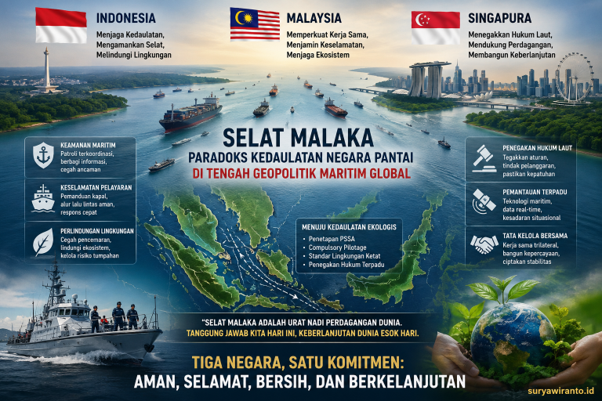
In the field of maritime diplomacy, the success of patrols in Natuna that resulted in the expulsion of 12 foreign vessels without conflict escalation in the last three months should be replicated in other areas prone to violations, such as the Arafura Sea south of Papua and waters around the Malacca Strait. The use of satellite-based monitoring systems and radar with artificial intelligence integrated with the Vessel Monitoring System (VMS) should have its coverage expanded, so that all Indonesian waters and areas of jurisdiction can be monitored in real-time. Maritime diplomacy must also actively use international forums to strengthen Indonesia’s legal position. In every UN meeting, ASEAN, and other multilateral forums, Indonesia must consistently assert that unilateral claims contrary to UNCLOS 1982 have no legal basis and will never be recognized by the international community. With a combination of credible hard power, advanced surveillance technology, and active legal diplomacy, Indonesia’s sovereignty over its waters will become increasingly robust.
5. Conclusion and Recommendations
Resilience diplomacy holds immense strategic potential to become Indonesia’s foreign policy doctrine amidst global fragmentation and the erosion of the rules-based order. However, this potential will only be realized if the concept is immediately defined operationally, bounded by clear priorities, and equipped with adequate policy instruments. Indonesia lacks neither resources, legitimacy, nor experience to play a more ambitious role on the global stage. The main challenge is not how to survive in an increasingly harsh world, but how to decide to act strategically within it. Without explicit strategic choices regarding national interests and leadership in the global arena, resilience diplomacy will degrade into a language of caution that replaces strategy, rather than strengthening it.
To that end, three main recommendations need to be implemented immediately. First, transform resilience diplomacy from a defensive paradigm into an instrument of national power projection, with concrete agendas such as leadership in the Indo-Pacific security architecture, active maritime diplomacy, and the shaping of regional norms. Second, strengthen ASEAN as the gravitational center of diplomacy to prevent strategic marginalization, through revitalizing the ASEAN Outlook on the Indo-Pacific, strengthening ASEAN collective security mechanisms, and firmly rejecting security architectures that sideline ASEAN centrality. Third, integrate resilience diplomacy with military modernization and maritime strategy to create credible deterrence, through accelerating defense equipment procurement, strengthening the domestic defense industry, and active maritime diplomacy in international forums.
The legal basis for implementing these recommendations is already available, ranging from the Preamble to the 1945 Constitution, Law Number 37 of 1999 concerning Foreign Relations, Law Number 3 of 2002 concerning National Defense, to various implementing regulations at the ministerial and agency levels. What is needed now is the political courage to translate this legal foundation into concrete, measurable, and bold policies. As affirmed in various multilateral forums, including in Foreign Minister Sugiono’s statement at the ASEAN-UN Summit, true strength lies in collaboration, not confrontation. Resilience diplomacy built on a foundation of collaboration, leadership, and credible power will make Indonesia not merely survive the geopolitical storm, but able to determine the wind’s direction for the stability and prosperity of the Indo-Pacific. This is the essence of truly ‘free and active’ foreign policy: not merely free to determine one’s stance, but actively shaping the world order.
Author Bio
Dr. Surya Wiranto is a Rear Admiral (Ret.) of the Indonesian Navy (TNI AL) and a senior strategic analyst specializing in Indo-Pacific security and maritime issues. He serves as an Advisor for Indo-Pacific Strategic Intelligence (ISI) and is affiliated with several Indonesian and international strategic and defense institutions. Dr. Wiranto lectures on Maritime Security and the International Law of the Sea at the Republic of Indonesia Defense University, and writes on middle-power diplomacy, geoeconomics, and the Indo-Pacific regional order.
BIBLIOGRAPHY
- Djalal, H. (2021). Indonesian Foreign Policy: Wawasan Nusantara and the Archipelagic State. Jakarta: Centre for Strategic and International Studies.
- Anwar, D. F. (2020). Indonesia’s Foreign Policy After the Cold War: International Pressure and Domestic Constraints. Singapore: ISEAS Publishing.
- Sukma, R. (2019). “Indonesia and the Indo-Pacific: A New Strategic Vision?” in Contemporary Southeast Asia, 41(2), 155-172.
- Laksmana, E. A. (2022). “The Politics of Military Modernization in Indonesia: Between Global Pressures and Domestic Interests” in Asian Security, 18(1), 45-63.
- ANTARA News. (2025, October 28). *Meneguhkan kepemimpinan diplomatik Indonesia setelah KTT ASEAN ke-47* [Strengthening Indonesia’s Diplomatic Leadership after the 47th ASEAN Summit]. Retrieved from https://www.antaranews.com .
- ANTARA News. (2025, October 30). RI harus arahkan ASEAN-PBB sebagai pilar utama multilateralisme global [Indonesia Must Direct ASEAN-UN as Main Pillar of Global Multilateralism]. Retrieved from https://www.antaranews.com .
- Asia Times. (2025, December 15). Trump’s NSS puts the squeeze on Indonesia’s strategic autonomy. Retrieved from https://asiatimes.com .
- Asia Times. (2025, November 14). Indonesia-Australia security pact a timely model for middle powers. Retrieved from https://asiatimes.com .
- Coordinating Ministry for Political and Security Affairs of the Republic of Indonesia. (2025, August 20). Kemenko Polkam Bahas Strategi Pencapaian Asia Power Index dalam RPJMN 2025–2029 [Coordinating Ministry for Political and Security Affairs Discusses Strategy for Achieving Asia Power Index in the 2025–2029 RPJMN]. Press Release No. 354/SP/HM.01.02/POLKAM/8/2025. Retrieved from https://polkam.go.id .
- MetroTVNews.com. (2025, October 15). Setahun Prabowo–Gibran: Diplomasi Bebas Aktif Indonesia Masuki Babak Baru [One Year of Prabowo-Gibran: Indonesia’s Free and Active Diplomacy Enters a New Phase]. Retrieved from https://www.metrotvnews.com .
- East Asia Forum. (2026, February 18). Indonesia’s diplomacy of resilience needs clearer strategy. Canberra: Australian National University.
- Wiranto, Surya (2026), “Result-Oriented Statecraft and Middle-Power Recalibration: Indonesia’s Foreign Policy under President Prabowo Subianto (2024–2026)”.
- Annual Press Statement of the Minister for Foreign Affairs of the Republic of Indonesia, Sugiono. (2026, January 14). Jakarta: Ministry of Foreign Affairs of the Republic of Indonesia.