Abstract
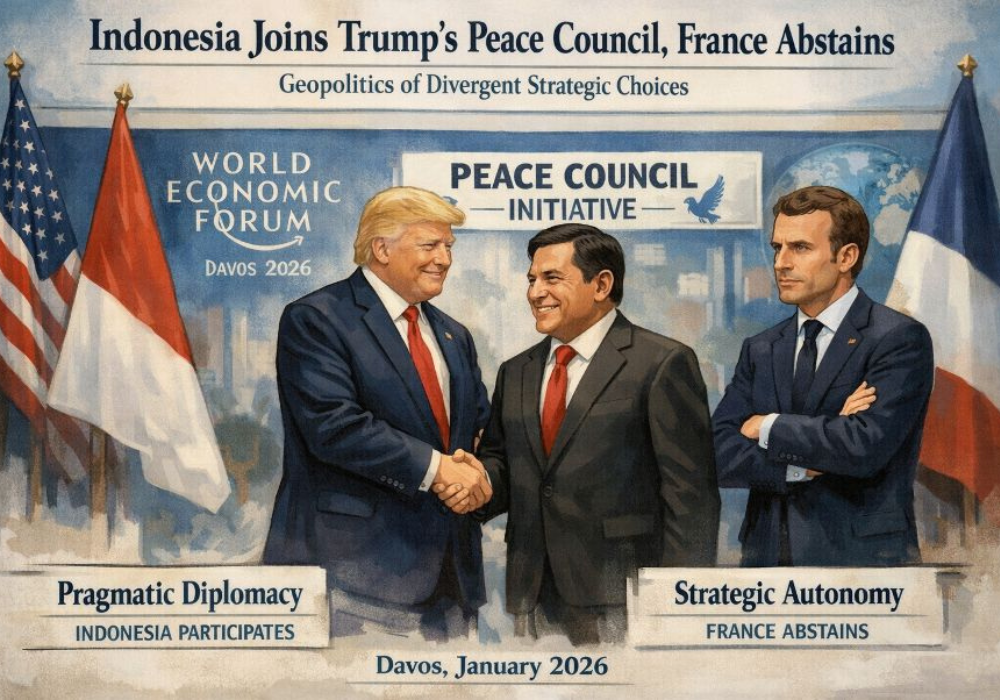
This paper examines Indonesia’s strategic rationale for participating in the peace council initiative promoted by U.S. President Donald J. Trump following the World Economic Forum in Davos, January 2026, and contrasts it with France’s decision under President Emmanuel Macron to abstain. Using a geopolitical and international legal perspective, the article argues that the initiative represents a structural shift from a rule-based multilateral order toward a deal-based peace architecture characterized by pragmatism, selectivity, and transactional bargaining. For Indonesia as a middle power, participation reflects an adaptive interpretation of the free and active foreign policy doctrine aimed at preventing strategic marginalization. France’s rejection, by contrast, is grounded in the doctrine of European strategic autonomy and a normative commitment to institutional multilateralism. The paper concludes that both positions are rational within their respective structural contexts and illustrate the fragmentation of global peace governance in the twenty-first century.
Keywords: Free and Active Foreign Policy, Deal-Based Peace, Middle Power Diplomacy, Strategic Autonomy, Multilateralism
1. Context: Global Disorder and the Emergence of Transactional Peace Mechanisms
The post-pandemic international system has entered a phase of intensified geopolitical volatility marked by prolonged interstate conflict, hybrid warfare, and the erosion of consensus-based multilateralism. Since the outbreak of the Russia-Ukraine war in February 2022, followed by escalating instability in the Middle East and the Red Sea throughout 2024-2025, traditional peace and security mechanisms under the United Nations framework have struggled to deliver timely and decisive outcomes. The United Nations Security Council, formally mandated by the UN Charter of 1945 to maintain international peace and security, has repeatedly faced paralysis due to veto competition among permanent members. This structural dysfunction has encouraged major powers to explore alternative, non-institutional avenues for conflict management.
Within this context, the peace council initiative advanced by U.S. President Donald J. Trump during 2025 and articulated more clearly at the World Economic Forum in Davos in January 2026 reflects a broader transformation in global governance. Rather than establishing a treaty-based organization, the initiative operates as a selective consultative forum that prioritizes leverage, coercive diplomacy, and material incentives over normative consensus. This approach aligns with Trump’s long-standing doctrine of peace through strength, whereby stability is pursued not through universal rules but through negotiated deals shaped by asymmetries of power. The emergence of such mechanisms signals a transition from institutional multilateralism toward a fragmented landscape of ad hoc peace arrangements.
2. Problem Analysis: Indonesia’s Strategic Calculus as a Middle Power
Indonesia’s decision to engage with the Trump-initiated peace council must be understood through the evolution of its free and active foreign policy doctrine, which is constitutionally rooted in the Preamble of the 1945 Constitution and historically articulated by Mohammad Hatta. In contemporary practice, this doctrine no longer implies equidistance from major powers but rather strategic flexibility aimed at maximizing national interests without formal alliance commitments. As a middle power located at the strategic crossroads of the Indo-Pacific, Indonesia faces increasing exposure to geopolitical spillovers, including disruptions to maritime security, energy supply chains, and regional stability.
Participation in an informal but influential peace mechanism offers Indonesia direct access to high-level decision-making processes that increasingly shape conflict outcomes outside formal multilateral institutions. Experiences such as Indonesia’s G20 Presidency in 2022 demonstrated that agenda-setting power often resides within limited forums capable of rapid coordination. From this perspective, abstention would risk relegating Indonesia to a rule-taker position in decisions affecting issues of direct national concern, including Indo-Pacific security dynamics and conflicts involving resource access and maritime chokepoints.
3. Risks and Normative Implications of Transactional Engagement
Despite its strategic rationale, Indonesia’s involvement in a deal-based peace architecture carries inherent risks. The absence of binding legal frameworks and accountability mechanisms exposes participating states to shifting political priorities, particularly given the precedent of unilateral U.S. withdrawals from international agreements during Trump’s 2017-2021 presidency. Moreover, active engagement in non-normative forums may generate perceptions of inconsistency with Indonesia’s longstanding advocacy for international law, including the UN Charter and the 1982 United Nations Convention on the Law of the Sea.
There is also a reputational dimension within the Global South, where Indonesia has traditionally positioned itself as a champion of inclusive multilateralism and South-South cooperation. Association with a power-centric initiative risks undermining this normative capital if not carefully managed. Consequently, Indonesia’s engagement must be framed as calculated participation rather than ideological alignment, with clear internal guidelines defining non-negotiable national principles.
4. France’s Rejection and the Logic of Strategic Autonomy
France’s refusal to participate in the Trump-led peace council reflects a fundamentally different structural position and strategic culture. As a nuclear-armed power and a leading actor within the European Union, France has invested heavily in the concept of strategic autonomy, emphasizing Europe’s capacity to act independently in security and defense matters. Since President Emmanuel Macron’s 2017 Sorbonne speech, this doctrine has guided French opposition to initiatives perceived as reinforcing U.S. dominance over European strategic choices.
Historical tensions with the Trump administration, including disputes over NATO burden-sharing and transatlantic trade, further reinforced French skepticism. From a normative standpoint, French strategic culture prioritizes legality, institutional continuity, and treaty-based governance, values that are difficult to reconcile with a transactional peace mechanism lacking formal legitimacy. Domestic political considerations, including parliamentary oversight and public sensitivity to sovereignty issues, also constrain France’s willingness to engage in ad hoc forums perceived as undermining European leadership.
5. Strategic Options and Policy Implications for Indonesia
In navigating a fragmented peace governance landscape, Indonesia’s optimal strategy lies in maintaining dual engagement. Participation in transactional forums should be explicitly positioned as complementary to, rather than a replacement for, commitment to UN-centered multilateralism. This approach allows Indonesia to leverage access while preserving normative consistency. Internally, coordination among the Ministry of Foreign Affairs, the Ministry of Defense, and relevant coordinating ministries is essential to ensure coherent representation and adherence to constitutional principles.
Indonesia can also utilize such forums to inject issues often marginalized in great-power diplomacy, including maritime security, resource-based conflicts, and civilian protection. By articulating clear red lines, such as non-alignment, respect for sovereignty, and adherence to international law, Indonesia can mitigate the risks of co-optation while enhancing its profile as a constructive middle power.
6. Conclusion
The contrasting responses of Indonesia and France to the Trump-initiated peace council illustrate how structural position, strategic culture, and normative orientation shape state behavior in an era of deal-based geopolitics. Indonesia’s engagement represents an adaptive interpretation of its free and active foreign policy aimed at preserving relevance and influence amid institutional fragmentation. France’s abstention, conversely, reflects a deliberate effort to safeguard strategic autonomy and normative leadership within Europe. Both approaches underscore the ongoing transition from a rule-based international order toward a more pluralistic and transactional peace architecture, posing enduring challenges for global governance.
References
- Acharya, A. (2018). The End of American World Order. Cambridge: Polity Press.
- Hatta, M. (1956). Mendayung di Antara Dua Karang. Jakarta: Bulan Bintang.
- Ikenberry, G. J. (2020). A World Safe for Democracy. New Haven: Yale University Press.
- Macron, E. (2017). Speech on European Strategic Autonomy, Sorbonne University, 26 September.
- United Nations. (1945). Charter of the United Nations. New York.
- World Economic Forum. (2026). Global Risks Report 2026. Davos.