Abstract
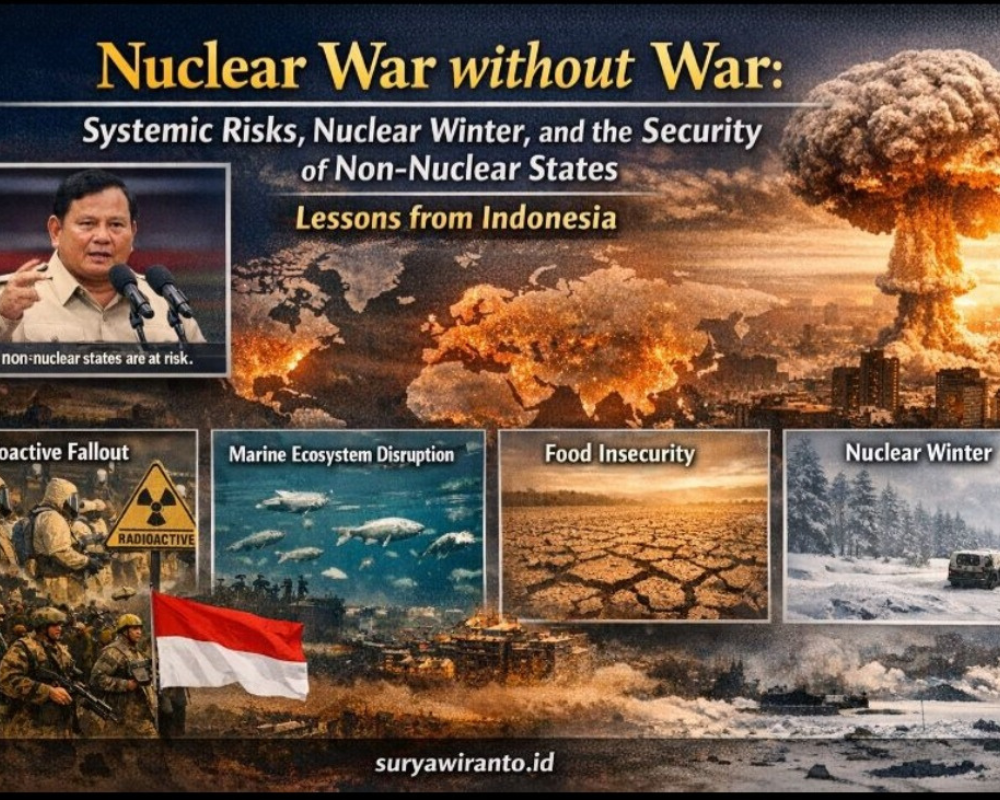
The statement delivered by the President of the Republic of Indonesia, Prabowo Subianto, at the 2026 National Coordination Meeting of Central and Local Governments highlights that contemporary nuclear war does not necessarily require direct military involvement by all affected states. Even non-belligerent and non-nuclear countries face systemic global risks arising from radioactive contamination, marine ecosystem disruption, food insecurity, and the long-term phenomenon of nuclear winter. This paper conceptualizes this condition as “nuclear war without war” and examines its strategic implications for Indonesia. Employing a qualitative normative approach and policy analysis, the study integrates global security theory, international law, Indonesia’s constitutional mandate, and non-military defense policy. The paper is positioned as a conceptual contribution to international conference proceedings on global security and twenty-first-century systemic risks.
Keywords: nuclear war, nuclear winter, systemic risk, non-military security, non-nuclear states, Indonesia.
- Introduction: Global Context and Indonesia’s Position
The global strategic environment in the mid-2020s has been characterized by intensified great power rivalry, the erosion of nuclear arms control regimes, and the renewed normalization of nuclear escalation rhetoric in international politics. Within this context, the statement made by the President of the Republic of Indonesia, Prabowo Subianto, at the National Coordination Meeting of Central and Local Governments in 2026, held at the Sentul International Convention Center on 2 February 2026, represents a significant articulation of strategic awareness. The President warned that global simulations indicate the possibility of a Third World War involving nuclear weapons, emphasizing that even countries not directly involved in hostilities would inevitably suffer from radioactive fallout, contamination of marine resources, and the onset of nuclear winter caused by atmospheric debris blocking sunlight for extended periods.
This statement reflects a fundamental transformation in the character of security threats. Nuclear war is no longer confined to the realm of military confrontation among nuclear-armed states, but rather constitutes an existential threat to global ecological systems and human survival. Since early Cold War scientific studies, climate models have demonstrated that large-scale nuclear detonations could trigger significant global temperature decline, disrupt agricultural systems, and induce widespread famine. For Indonesia, an archipelagic state with extensive maritime territory and high dependence on marine resources and food systems, such indirect effects pose a profound threat to national resilience and societal stability.
Traditional state-centric security approaches focused on territorial defense are increasingly inadequate for explaining these risks. Human security and environmental security frameworks provide a more relevant analytical lens, placing human survival, ecological sustainability, and societal resilience at the core of national security. This perspective is consistent with Indonesia’s constitutional mandate, as articulated in the Preamble to the 1945 Constitution of the Republic of Indonesia, which obliges the state to protect the entire nation and to contribute to a world order based on lasting peace and social justice.
- Problem Analysis: Nuclear War as a Systemic Global Risk
The primary challenge facing Indonesia in the context of potential global nuclear conflict lies in the transboundary and non-conventional nature of the threat. As a non-nuclear and non-belligerent state, Indonesia exercises no direct control over nuclear escalation dynamics, yet remains highly vulnerable to their consequences. Radioactive particles transported through the atmosphere and ocean currents render territorial boundaries irrelevant in mitigating exposure and environmental harm.
The ecological consequences of nuclear war represent a structural risk to Indonesia’s food security. Radioactive contamination in marine ecosystems may bioaccumulate through food chains, directly affecting fisheries that support national nutrition and the livelihoods of millions of coastal communities. Moreover, nuclear winter, characterized by reduced sunlight and declining global temperatures, would suppress agricultural productivity on land, increase food price volatility, and heighten the risk of social instability.
From the perspective of international law, nuclear weapons have long been recognized as posing catastrophic humanitarian consequences. Numerous United Nations resolutions acknowledge the indiscriminate and transboundary effects of nuclear weapons use. Nevertheless, existing international legal regimes remain limited in their capacity to provide effective protection for non-nuclear states against the indirect environmental and humanitarian impacts of nuclear conflict. Although Southeast Asia is designated as a Nuclear-Weapon-Free Zone under the Bangkok Treaty, this regional framework cannot shield its members from the global climatic and ecological consequences of nuclear war occurring elsewhere.
At the domestic level, Indonesia’s legal framework has acknowledged the existence of non-military threats to national security. Law Number 3 of 2002 on National Defense and Law Number 23 of 2019 on the Management of National Resources for National Defense explicitly recognize that threats to national survival may arise beyond conventional military aggression. However, the mainstreaming of global nuclear risk into national planning and cross-sectoral policy frameworks remains underdeveloped.
- Policy Framework: Integrating Non-Military Security and Global Governance
Addressing the complexity of nuclear war as a systemic global risk requires Indonesia to adopt an integrated non-military security approach within its national defense doctrine. The concept of total defense provides a foundational framework for mobilizing state institutions, society, and national resources in response to multidimensional threats. Within this paradigm, national resilience is measured not solely by military capability, but by adaptive capacity in the face of environmental and humanitarian disruptions.
At the international level, Indonesia is well positioned to strengthen its role as a normative actor in nuclear disarmament and humanitarian impact discourse. Through consistent engagement in the United Nations, the Non-Aligned Movement, and ASEAN, Indonesia can advocate for the recognition of non-nuclear states’ rights to protection from the environmental consequences of nuclear conflict. This approach aligns with Indonesia’s long-standing “free and active” foreign policy, emphasizing proactive norm-shaping rather than passive alignment.
Domestically, policy solutions require the strengthening of scientific and institutional capacity. Environmental radioactivity monitoring systems in marine and atmospheric domains should be integrated into national early warning mechanisms. Furthermore, incorporating global nuclear risk into food security, public health, and environmental protection policies represents a strategic step toward reducing national vulnerability. These measures are normatively grounded in the precautionary principle of environmental law and the state’s obligation to guarantee the right to a healthy environment.
- Policy Implications and Strategic Action
Translating the proposed framework into concrete action demands policy coherence and cross-sectoral coordination. National development planning instruments, including the National Medium-Term Development Plan, should incorporate global risk scenarios such as nuclear war and its environmental consequences. This approach situates preparedness as an element of risk governance rather than an ad hoc crisis response.
Inter-ministerial coordination is essential to addressing multidimensional threats. Ministries responsible for defense, foreign affairs, environment, maritime affairs and fisheries, and public health must operate within a shared operational framework to manage potential radioactive contamination and food system disruption. The involvement of local governments is equally critical, given that the most immediate impacts would be felt at the community level, particularly in coastal and agricultural regions.
Public risk literacy constitutes an additional strategic dimension. Science-based public education regarding global risks and nuclear war impacts should be promoted to enhance societal preparedness without inducing panic. From a legal standpoint, this obligation aligns with citizens’ right to information and the state’s duty to safeguard public safety.
- Conclusion
The concerns expressed by President Prabowo Subianto regarding the potential consequences of nuclear war underscore the necessity of redefining national security in an era of global systemic risk. Nuclear war demands a policy approach that transcends sectoral and disciplinary boundaries, integrating human security, environmental sustainability, and national resilience into a unified framework. For Indonesia, preparedness for nuclear war impacts represents not pessimism, but the fulfillment of constitutional responsibility to protect the nation and contribute to global peace.
As a contribution to international conference proceedings, this paper argues that non-nuclear states such as Indonesia cannot be positioned merely as passive observers in global security dynamics. Through policy integration, normative diplomacy, and capacity building, Indonesia can actively shape international discourse on security, peace, and the sustainability of human civilization.
References
- 1945 Constitution of the Republic of Indonesia.
- Law Number 3 of 2002 on National Defense.
- Law Number 23 of 2019 on the Management of National Resources for National Defense.
- United Nations. Resolutions and reports on the humanitarian impact of nuclear weapons.
- CNBC Indonesia. Coverage of the statement by the President of the Republic of Indonesia regarding the risk of global nuclear war at the 2026 National Coordination Meeting of Central and Local Governments, 2 February 2026.